
Welcome friend! If your experience is anything like mine, you have heard of dopamine. Often associated with pleasure, I had a very basic understanding of this amazing chemical in my body. To learn more I picked up The Dopamine Code: How to Rewire Your Brain for Happiness and Productivity by Dr. Sydney Ceruto. Take a look at what the book is about and then read on for my initial thoughts.
The Dopamine Code

The Dopamine Code is a game-changer for brains feeling stuck, scattered, or buried under a mountain of to-dos—especially if you’re constantly chasing happiness or struggling with focus and time management. Packed with science on dopamine and how it impacts your motivation and drive, it offers practical strategies like creating dopamine menus to spark joy, reduce overwhelm, and actually get things done without burning out.
Have you ever felt stuck or scattered? Like you’re constantly chasing happiness? The answer is found in the brain chemical that determines how satisfied (or unsatisfied) you dopamine. Discover how to rewire your brain for more happiness, motivation, mental clarity, and productivity with The Dopamine Code!
Blending neuroscientist Dr. Sydney Ceruto’s research with real-life examples, this book covers the basics of dopamine and how you can work with your brain to spark joy, increase focus—including focus for ADHD—and reduce overwhelm through better emotional regulation and energy management. Each chapter contains an exercise to help you apply what you learn to work, relationships, creativity, and more. You’ll also find a guide for creating your own Dopamine Menu—a toolkit of routines and strategies that match your unique strengths, values, and lifestyle.
Whether you’re navigating school, work, or are simply trying to make it through the day without burning out, you’ll find a game-changing blueprint that’s doable, sustainable, and easy to understand. A more motivated and fulfilling life is within reach…it’s time to crack the dopamine code!
The Dopamine Code – Thoughts on Part 1
As a regular reader of nonfiction, I have many approaches to reading a book. Depending on how familiar I am with the material, the style of writing and how technical or practical the topic is, sometimes I can breeze through it and other times, the book is going to be a slow read. I have been chipping away at The Dopamine Code for many months now.
In this post, I will be talking about Part 1 of the book – the basics around dopamine. I am choosing this path of a part-by-part review for two reasons: first, it is a good recap for me on what I have read. And second, it gives you insight about this book before we jump into a conversation with Dr. Ceruto.
The Dopamine Code promises to be an action guide towards rewriting the brain and in the very first chapter, it becomes clear on how it is going to do that. It builds an understanding of what dopamine is, how it is linked to our evolution, what one’s personal relationship to dopamine may be and how we can use small intentional shifts to do better. The idea is to build a personal toolkit by the end of the book that will make our lives happier and more satisfying. But small intentional shifts will come from focused work and that is what each chapter is designed to do. The chapter structure encouraged me to take time to pause, reflect and take action.
If you have read any nonfiction about the human body, you would know how hard it is to talk about one thing in isolation. The versions we read in school are nothing like the true orchestration that takes place in our bodies. We are a complex system of nerves and hormones and nothing is as simple as “pleasure chemical”. Dopamine works in an ecosystem and Dr. Ceruto does a really good job of putting it in the context of evolution, our nervous system as well as our environment. I still found it a lot to wrap my head around and it was helpful that the book has key definitions in separate boxes to make them more accessible should I need to revisit a term.
Dr. Ceruto draws on profiles of numerous people who were doing great in their personal or work lives but after a while, they lost touch with the happiness of their actions. These profiles were brief yet they paired really well with the concept tackled by the chapter. They gave an insight into the strategies used by these people to overcome their challenges. This felt like ideas I can tap into when I finally go to build my dopamine menu.
The first part of the book is composed of four chapters:
- What is Dopamine?
- The Dopamine Paradox
- The Pleasure-Pain Balance
- The Dopamine Myths
Here are four insights that I wanted to highlight:
Insight 1 — Anticipation
Your brain did not evolve to bask for long in satisfaction; anticipation is your default mode, not a design flaw.
Page 24
Since becoming a mom, I have thought about early humans a lot. The way our bodies are built, the way we function has a lot to do with the years of evolution from a long time ago. A lot of our chemical composition is actually ancient and learning about how dopamine is something I share with my ancestors was fascinating to me. The brain does not cherish comfort though it does like it. What it loves though is moving forward towards something. If you are a goal oriented person like me, you would understand this drive. I know not everyone is like that and The Dopamine Code also goes into attention-deficit/hyperactivity disorder (ADHD) and its relationship to dopamine.
This also closely relates to the second insight:
Insight 2 — Persistence
The ability to persist after setbacks, to recover your optimism, or to try a different approach is fundamentally a dopamine story.
Page 27
I had never thought about persistence and optimism as part of the dopamine story. I have often associated persistence with willpower and determination, but this quote made me think about what happens when things don’t go as planned.
What helps us recover from a setback, believe that another approach might work, and find the motivation to try again?
I find it interesting that persistence – something often seen as a mindset – has a biological dimension. It makes me curious about how much of our ability to keep moving forward is shaped by the way our brains respond to the possibility of a reward.
Insight 3 — The savanna and Instagram
The brain doesn’t distinguish between tracking prey across the savanna and acquiring “likes” on an Instagram post; both register as potential rewards. By understanding this evolutionary mismatch, you can begin to break the cycle. When you feel the restless urge for “what’s next” just moments after a win, it’s not a personal weakness; it’s a Stone Age survival tool working in a twenty-first century world.
Page 37
To change my thinking, I have to encounter an idea many times. Sometimes, I can fall into the false narrative that something is wrong with me but truly I just don’t understand what is happening in my body. This is something I have worked on with pregnancy and my perception about pregnancy hormones. I noticed that Dr. Ceruto repeats ideas to reinforce that the things we think are wrong with us are actually how our brains are wired. The contrast in this quote between the savanna and Instagram is hilarious and jarring at the same time.
Insight 4 — Intelligent design
Your brain doesn’t heal through deprivation; it heals through intelligent design.
Page 74
This is one of my favorite quotes from the book so far! It highlights how our actions can change how we heal. Since the motto here is to take small intentional steps towards change, it actually forces us to think about what it is we are working towards and how to do it progressively rather than in one sweeping gesture.
I think my relationship to writing and how it evolved after my daughter. Before I could sit and write a whole review without being interrupted, after her arrival, life started to have a lot more interruptions. Rather than being annoyed at the lack of time, I started to appreciate the time I did get and changed my thinking that even 10 min of writing was enough. My goal wasn’t to finish the review in one sitting. It was simply to put my thoughts down. That’s a perspective change. Rather than using my laptop as my tool to write reviews, I started to leverage my phone’s Notes app to write as well as taking notes in my journal. Giving myself permission to use different devices and creating a system to track when I return to writing has been a great enhancement to the design of my writing. I didn’t even know my process had a design until I redesigned!
I want to relate this back to Insight # 2. Persistence can look different – it can be repeating an approach until it works. In the case of writing, it would have been making sure I could find dedicated time pockets to review books without interruptions like I used to. Or it can mean trying something new. That’s what I did by giving myself permission to write on paper or on my phone, focusing on the little things I could accomplish and leaving the completeness of the review for later.
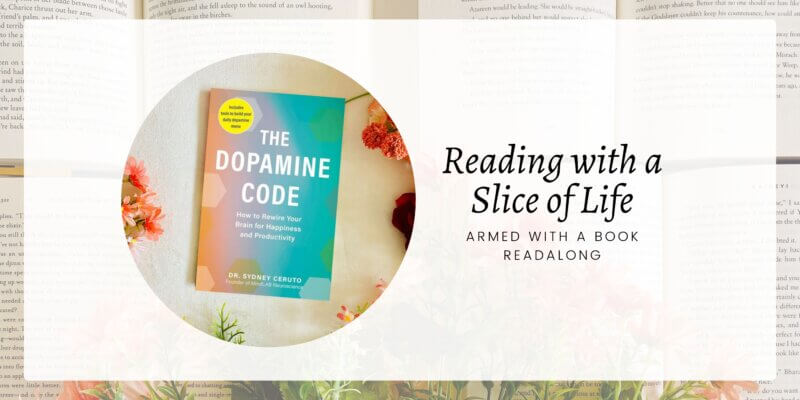
You may have noticed that this post is a new addition in Reading with a Slice of Life series! It follows a completely different format from The Names and I think that is fitting as they invite different reading and writing experiences, rather than just being different books. I posted The Names pauses in succession as I had them all written out. In the The Dopamine Code, I am letting the rhythm of life manage the reading. I am not sure when I will be back with thoughts on part 2 but I can assure you that it will happen.
At the time of writing this review, I am halfway through the second part of the book which is all about navigating a world. It is quite interesting as it highlights how social media, AI and dopamine interact together and I am excited to put my thoughts down on paper.
You can follow the full series on the home page of the series as new and old posts are collected there.
Read more about The Dopamine Code on Goodreads.
I hope you enjoy the next post – a conversation with Dr. Ceruto about The Dopamine Code.
Many thanks to the publisher for a review copy of the book for my honest thoughts. I am forever grateful for the books that meet me in my mailboxes.

Be First to Comment