
Welcome, friend! Some stories pull you in with their mystery, but what stayed with me while reading Oxford Soju Club by Jinwoo Park were the questions it raises about identity, belonging, and the versions of ourselves we carry.
Set against the backdrop of Oxford, the novel brings together spies, immigrants, and hidden pasts, all connected through a single, unassuming restaurant. As their stories intersect, the lines between truth and identity begin to blur. I found myself drawn not just to the tension of the plot, but to the emotional undercurrent of what it means to live between worlds and to constantly redefine who you are. As an immigrant, I relate to that.
I’m excited to welcome Jinwoo Park to Armed with A Book today to talk about writing across perspectives, exploring identity through a genre lens, and the stories we tell—both to others and to ourselves.
Here is what Oxford Soju Club is about:

The natural enemy of a Korean is another Korean.
When North Korean spymaster Doha Kim is mysteriously killed in Oxford, his protege, Yohan Kim, chases the only breadcrumb given to him in Doha’s last breath: “Soju Club, Dr. Ryu.” In the meantime, a Korean American CIA agent , Yunah Choi, races to salvage her investigation of the North Korean spy cell in the aftermath of the assassination. At the centre of it all is the Soju Club, the only Korean restaurant in Oxford, owned by Jihoon Lim, an immigrant from Seoul in search of a new life after suffering a tragedy. As different factions move in with their own agendas, their fates become entangled, resulting in a bitter struggle that will determine whose truth will triumph.
Oxford Soju Club weaves a tale of how immigrants in the Korean diaspora are forced to create identities to survive, and how in the end, they must shed those masks and seek their true selves.
Get to know the author: Jinwoo Park
Hi Jinwoo! Welcome to Armed with A Book. It is a pleasure to chat with you. Please tell me and my readers a bit about yourself.
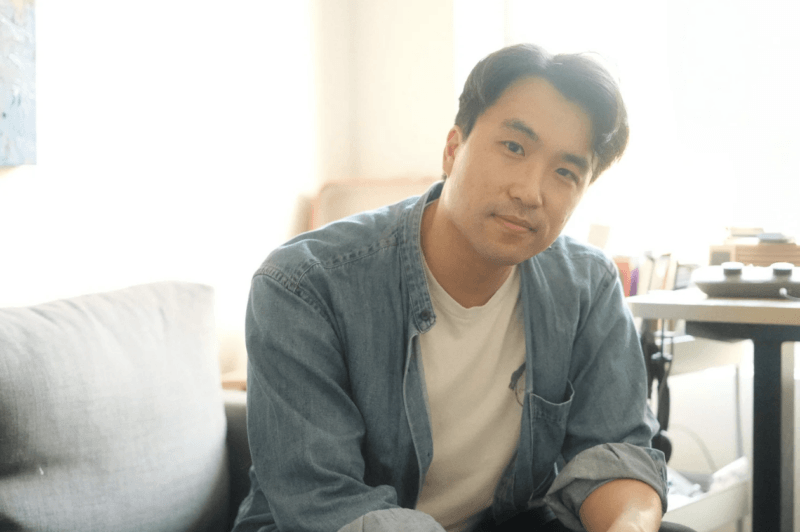
Thank you for having me on here! It is a pleasure as well. I’m a Montreal-based Korean-Canadian writer and literary translator. I was born and raised in Seoul, before moving to Canada when I was 11. Afterwards, I lived in various places in Canada, the US, and the UK, before finally settling where I am now.
Oxford Soju Club opens with Yohan discovering his mentor, Doha, shot in an alley. Doha’s presence lingers throughout the book through his advice and instructions. Can you tell me about writing Doha and shaping his influence on Yohan?
In many ways, Doha and Dr. Ryu are surrogate parents for Yohan, and through them I tried to examine the relationship immigrant children have with their parents. In fact, I’ve drawn quite a lot from my own relationship with my parents. They had this view that we were strangers in a hostile environment, and that I needed to strictly follow their advice in order to survive. But what I’ve learned is that the way they view the world is remarkably different from the way I view the world, as well as from the way the world actually is. So Yohan’s journey follows this ‘shedding’ of his parental figures’ influence. He has all these lessons from Doha and Dr. Ryu that he reminds himself of, but in the end, he must make his own path in order to not just survive, but thrive.
For readers who may not be deeply familiar with the tensions between North and South Korea, what context would you want them to keep in mind before diving into this book?
I wouldn’t say that readers need a deep knowledge of the context between North and South Korea to enjoy this book, other than that the North is incredibly authoritarian. In fact, through the North, I wanted to express the ‘tyranny’ of the motherland. The grip that our homes have on our minds as we try to adapt to our adopted countries. I think our connection to our home countries can be a positive influence, but also a negative influence. It can be something that holds us back. I’ve seen that manifest in many ways among fellow Korean immigrants. It’s not to say that we have to throw away our connection to the homeland, but I think we should come to grips with what our homeland means to us.
You chose to tell this story through the perspectives of two young spies, Yohan and Yunah. What drew you to these parallel viewpoints, and what did each allow you to explore differently?
Because I intended this novel to be a metaphor for immigrant life. Yohan and Yunah are two archetypes of immigrant children that I’ve experienced throughout my life, having been those archetypes as well myself. Both are spies. They have an alias that they put out to the world, while keeping their true selves hidden. This is pretty much what I feel is the immigrant experience. You have a facade that you present in order to be accepted, and you keep your real self, often the one that is culturally closer to your motherland, concealed. And their internal conflicts represent the irreconcilable gap that many immigrants are burdened with. They have to adapt because that’s how you survive, but no matter how much you adapt, you’re never quite fully accepted. Through Yohan, I was able to examine the limits of mindlessly adapting to your adopted country. Through Yunah, I was able to reflect on what happens when all your efforts to be accepted only end with people ‘othering’ you. And most of all, I wanted to see what answers these characters would arrive at, partly to figure out what that answer would be for me.
Yohan is constantly adapting—languages, loyalties, identities—while Yunah carries a deep frustration at not being fully trusted. How did you approach writing their emotional interior lives alongside the espionage?
There’s a lot from my own life that I dug into for this book. That’s the reason why I jokingly call this book my ‘self-therapy.’ I think Yohan represented a period of my life when I was confused about what I needed to be as a Korean-Canadian. So I tried everything in order to be Canadian as much as I could. I’d take up hobbies or interests that I actually didn’t enjoy, but just for the sake of ‘being Canadian.’ Yunah also does this, but she takes it even further, and has this passive contempt for other Koreans and her culture. This, too, reflected thoughts that I would harbor when I was younger. I’d let my desire to assimilate overwhelm my sense of being a Korean. So their emotional journeys are closely aligned with my own emotional journey I had to take in order to attain a more secure sense of self as a Korean-Canadian immigrant today.
Dr. Ryu is a mysterious but pivotal figure in Yohan’s life. Without spoilers, what can you share about Dr. Ryu?
Dr. Ryu is someone who longs for meaning. She’s this incredibly intelligent and worldly woman who desires her abilities to be used for a higher purpose outside of herself. So all of her achievements, including her doctorate in psychology, she does for the sake of that purpose, and with her being a North Korean, that purpose lies with the Dear Leader. This makes her a foil to Doha, the careless hedonist whose priority is himself, and I think that makes them a rather interesting pair of parental figures to Yohan.
The Soju Club is the only Korean restaurant in Oxford, and it becomes a crossroads for spies, immigrants, and secrets. Why did food—and this particular space—feel like the right setting for the story?
To me, food is the most visceral and instinctive way we connect with our home culture. There’s nothing like it. You’re in a strange place, you walk into a restaurant, and you order a meal you know from your motherland. At first whiff, it takes you back. You’re home even before you start eating. At least that’s how it always felt like for me. Back in McGill, in Montreal, there was this one Korean bar where my friends and I would go to have soju and budaejjigae. That space always had this warmth and welcome that you couldn’t feel elsewhere. That was the feeling I wanted to recreate with the Soju Club.
When you first got the idea for this novel, did you always know the Soju Club would become the center of the novel’s collision of worlds?
Not exactly. At first, Soju Club was an important location, but not where they all collided. In the beginning I was thinking about it more in terms of how a traditional spy thriller would globetrot, so the book would jump from Seoul, to Brussels, to Paris, to London, and then to Oxford. You can still see the traces of that throughout the book. Then a close friend gave me feedback that maybe I should keep it all happening in Oxford to make the action more claustrophobic, thereby leading to more interesting interactions between characters. Once it was all happening in Oxford, it just became inevitable that the Soju Club would become the center of the novel’s action.
This is a novel full of aliases and covers. How did you keep track of the many identities your characters inhabit while writing?
The short answer is that it was very difficult to keep track of the many identities. Sometimes Yohan would call Yunah, Yunah, instead of Seonhye, her alias, when Yunah never told Yohan his real name. That sort of thing happened constantly in earlier drafts of the book. So I’d say meticulous editing by very talented people (like my editor Julia Kim) helped me to keep track of the different identities. I’ve learned my lesson and now when I write a novel length project, I always have an outline that keeps me on top of all the details.
Was there a character whose storyline surprised you the most as you wrote—someone who evolved beyond your original plan?
Jihoon surprised me the most, because he was the most cliched Korean character. I intended him to be this extremely Korean version of an immigrant who never lets go of their roots, in contrast to someone like Yunah who’s the opposite of where Jihoon is. This was my ‘k-drama’ trope character, and he ended up having so much depth that I didn’t care about what I originally intended. And it taught me something important, which is that good characters only come out when they’re allowed to have the multi-faceted nature that all people have in reality, instead of trying to have them hamfisted into some grand plan of the author.
If you could meet one character from the novel, dead or alive, who would you want to have soju with—and what would you ask them?
This constantly changes, but right now, I think it would be Doha. It’d be wonderful to have his perspective on all sorts of things, including what’s happening in the world right now. I also think he’d be a fun drunk to hang out with. But the one thing I definitely want to ask him would be his thoughts about reunification.
What do you hope readers carry with them after they close Oxford Soju Club—about identity, truth, or the cost of survival?
I hope that readers learn to see the masks that they have accumulated themselves throughout their lives. I hope that they then start the journey to taking those masks off and revealing their true selves to the world. Because that’s how we truly thrive, when we are as authentic as we can be, no matter what anyone says or does about it.
Long before publishing this novel, you worked on narrative projects like game design and a short film. How did those experiences shape the way you think about storytelling on the page?
Game design really forces you to think about the ‘experience’ of someone going through the story. There’s this balance you must achieve between how much you empower the player versus having them go along the pre-determined path, because you want them to be always ‘engaged.’ That’s something that has definitely affected how I approach writing. With this particular book, that meant adjusting how much information I would give the reader, while determining which puzzle pieces to conceal in order to draw out as much engagement from the reader as possible. It also meant that I tried hard not to spoon feed everything to the reader, allowing some room for them to figure out the whole picture themselves. I believe that’s an essential part of a satisfying reading experience.
Is there anything else you would like to add?
I’d like to thank every single person who has read my book!
Thank you so much for taking the time to chat with me!
Many thanks to Hollay from River Street Writing for connecting me with Jinwoo and providing a review copy of the book for an honest review. Learn more about Jinwoo on his website.
Thank you for joining us!
Read my review in the last post.

Be First to Comment