Welcome friend! Since I started writing essays, I have thought often about the place stories have in my life. They are how I experience other realities through my experience of the author’s imagination, whether it is something I can relate to or something that is completely out of reach for me. Take this very story, Ignore All Previous Instructions by Ada Hoffmann, for example. I can imagine living on one of Jupiter’s moons (not something I will ever experience first hand) and experience what it means to be a supervisor for stories written by AI (I do this in another capacity when I use AI for coding or brainstorming).
That is what stayed with me most about Ignore All Previous Instructions. There is a lot happening in this novel: artificial intelligence, censorship, queer identity, neurodiversity, coming of age, technology, work, imagination, and the question of what makes a meaningful life. At times, it felt like there was too much for me to think about, but there were also ideas I found myself returning to long after I put the book down.
Take a look at the synopsis and then read on for my thoughts.
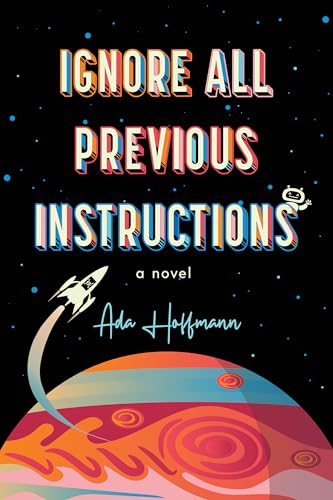
A script supervisor for an AI media conglomerate is caught between her intense need for an orderly life and her deeper, darker queer desires. From the creator of the Outside trilogy, a heartfelt interplanetary epic of identity, longing, and a space pirate who smuggles inappropriate stories.
Kelli Reynolds loves creating stories more than anything in the world. But on Callisto, a generative AI company called Inspiration owns everything, including all the media, and only Inspiration determines which stories can be told.
Kelli has a rare and coveted job in which her autism is to her advantage: She precisely edits AI output into “appropriate” stories for Inspiration’s massive TV audience. Her proudest creation is the pirate Orlando—a dashing do-gooder based on stories she used to tell friends.
Reenter Kelli’s ex-boyfriend Rowan, the person Kelli based Orlando on. Back when they were teenagers, their relationship was a secret. Kelli had thought that Rowan, a trans man, was her schoolmate Em, a girl.
Rowan is tangled up in the black market after he needed to get money for gender reassignment surgery. He needs Kelli’s help with something . . . illegal. So, now Kelli has to decide: Will she risk the safe, tidy story of her life now for the world she once wished for? What would Orlando do?
Passionate, dangerous, and tender, Ignore All Previous Instructions is a sweeping, poignant novel about censorship, forbidden love, and growing up.
Ignore All Previous Instructions – Review
Ignore All Previous Instructions has alternating chapters from two perspectives in two timelines. Kelli, in the present, is 24 years old. Am in the past recounts what it was like growing up and having Kelli as a friend.
On Coming of Age
The coming-of-age aspect was what interested me most.
A lot of the early years chapters show what it is like for teenagers to discover their sexuality and interests. Kelli is a natural storyteller and that draws Am into her circle. They expand into a trio eventually.
I really enjoyed how observant Am is. When Am is able to get a hold of the illegal media, it brings new understanding to the three girls. In the society that Kelli, Am and Elaine live in, queerness is a secret. The stories do not reflect it. As it naturally happens during puberty, the girls get curious about their interest in other people which goes beyond friendship.
Stories give us the opportunity to experience lives and possibilities that may be completely out of reach for us. The girls are doing this in a very literal way. They are using stories to discover themselves. I loved how Kelli, Am, and Elaine dig into illegal media to understand themselves and think about what they want their future to be.
As teens, our ideas of the lives we want are like broad strokes. As life unfolds, the picture comes into focus and the shapes become sharp.
Kelli and Am were quite close for a long time and I was curious about their fallout. In the present, Kelli is quite awkward with Rowan (Am) and it’s not because she is mad at him. At least, that’s not how it comes off to me.
On the World
One thing I kept thinking about was how far removed this society is from Earth, while so many of its conflicts feel familiar.
The world Kelli, Am and Elaine live in is advanced in many ways. Basic housing means people don’t work more than they have to. Robots can accompany children and teach them etiquette. AI can be used for therapy and guidance. The last two are already happening in our world.
In some ways, the world has advanced and gotten over many of the issues we face today and yet it is so tightly controlled.
That contradiction was fascinating to me.
The biggest example is that from the very start, children do not learn to pursue their imagination in the usual sense. They can only write with AI. Human-written stories are illegal.
Maybe I am supposed to be uncomfortable about giving AI the baton for doing all the writing. Maybe I am supposed to hate the fact that the progress of a story is defined by the audience and takes their input into consideration rather than a person’s imagination.
I am neither of those things.
I am able to sit in my reality and experience that one. It is too dystopian for a planetary conglomerate to control all these things and I don’t see it happening in my lifetime. And if it happened, I would just write anyway, the same way Kelli used to engage in storytelling when she was young.
Kelli is a natural storyteller and she is able to work with AI to keep writing. As one of the characters points out in the chapters that take place in the present, she is a sensitive person. Her imagination is very strong and she can be easily influenced while also influencing things. What a unique trait!
On AI and Storytelling
The novel makes an interesting distinction between AI that assists humans and AI being treated as a replacement for human creativity. AI as an assistant comes up often in contemporary fiction now and this novel takes it a step further where a robot can accompany a child to school to “teach her etiquette”. Am finds Kelli’s robot hilarious and challenges its recommendations all the time. The girls have a lot of fun retraining it.
Kelli’s job when she grows up is also fascinating. She takes AI-generated stories and makes them “appropriate.” She is allowed to inject her ideas but to a minimal level and since I don’t know what all she has changed and what she kept, it is hard to say how much her creativity influences the final product.
Kelli grew up telling oral stories that the girls in her class would act out. Maybe being able to create in some capacity brings enough meaning to her life.
On the Two Timelines
The two timelines were a mixed experience for me.
I usually don’t mind this format, but in this story it was not serving well. As a reader, I did have the choice to read the chapters I wanted in the order I wanted, and at 62% I decided to finish the past before getting back into the present.
That ended up being the right choice for me.
I was interested in the past. Kelli and Am were quite close for a long time and I wanted to understand their fallout. There was a fire that was set and that had certain consequences. This also shed light on why Kelli is alone in the present. She moved away from Basic Housing once she got the job with Inspiration and the past timeline gave me a lot of history about Kelli and Am.
The present-day story, on the other hand, did not create the same urgency for me.
The daughter of a gangster is obsessed with Orlando, a fictional character in Inspiration’s latest show that Kelli is supervising. Rowan owes a lot to this gangster and is charged with getting Kelli to meet the daughter as a birthday present. When the girl cannot convince Kelli to give Orlando’s kernel to her—she wants to have Orlando for herself—Kelli is blackmailed and forced to join this “heist” to steal Orlando’s kernel from Inspiration.
While I use AI in my everyday life, I can’t take the leap to be obsessed with a virtual creation to the point that someone wants to have it for herself. I believe this obsession has something to do with how storytelling is only through working with AI in the world that this girl grows up in, but no matter what, this feels like a childish whim.
Stealing digital property from an organization is not a light matter in any world but I guess the daring is what makes gangsters gangsters.
The whole adventure with Rowan does show a different side of Kelli. As Elaine points out in the past, Kelli is quite smart. When she is cornered into working for the gangster, Kelli wants the heist to fail. She already had a hunch that she was getting into something illegal when Rowan contacted her and she had set her supervisor up with a private link. I liked Kelli’s foresight.
The challenge is that Kelli isn’t very interesting to me as a narrator. She is good as a supervisor, writing stories with the AI, and using her influence to the maximum allowed level. She is a creature of habit and breaking those habits to travel with Rowan is a huge step for her. But I just don’t feel an emotional connection to her.
I enjoy young Kelli and her coming-of-age story much more.
On the Author’s Note
The author’s note ended up giving me a lot more insight into Kelli and Rowan’s character arcs, including the inspiration from neurodivergence, gender dysphoria and fluidity.
The fallout itself also made sense. Kelli and Am were hurting and they did something very dangerous that could very well have destroyed the whole colony on Callisto, the moon on Jupiter where they lived.
Ada’s note gives me vocabulary to talk about Kelli and Am when I don’t have the lived experience.
And isn’t that another beautiful thing that stories do?
I don’t have to share an experience with a character to be invited into their world. A story can give me vocabulary for experiences that are not my own. It can make me curious, help me recognize something I would not otherwise have the language to describe, and allow me to sit with someone else’s reality for a while.
When I Close the Book
There is a lot that I found worthwhile in Ignore All Previous Instructions.
I think this is one of the best representations I have seen of neurodiversity, queerness and coming of age. I loved the young Kelli and Am and the way they used stories to understand themselves. I enjoyed thinking about AI, human creativity and the question of who gets to decide what stories are allowed to exist.
At the same time, the book tackles a lot. While I don’t have to care about every character and situation, I felt like there was too much for me to think about. The present-day heist never became compelling to me in the same way that the coming-of-age story did.
I might have enjoyed this book if it was a linear timeline rather than jumping from present to past and back to the present. The past was the story I wanted to follow, and once I had finished those chapters and read the author’s note, I was satisfied.
I didn’t need to force myself through the remaining story simply because I had started it.
Instead, I followed the part that was still speaking to me.
And perhaps that is fitting for a book so interested in stories and imagination: sometimes we find ourselves in the story we are reading, and sometimes we discover that the part we most needed to experience was not the part we expected.
Thank you for reading my thoughts on Ignore All Previous Instructions! It is a powerful story in the speculative fiction genre, allowing an exploration of Earth issues by setting them on Jupiter. Move humanity to Jupiter and some things remain remarkably familiar… They will try to influence and control other humans, sometimes with speech and media, other times with technology. If you would like to take a look, check out the book on Goodreads.
The book made me conscious of my own use of AI for editing and organizing and I love the collaboration. Many times, it gets me started and I feel like my words are being “read” and refined.
In the last two years, AI has become a big part of publishing and everyone has their opinion. Whether it is the use of AI for making the cover or using it for storytelling, I have seen many versions. Personally, I appreciate when authors tell me how they used AI in their story, should they want to. The reason I say yes to a story is for the story and not the creative process itself.
That is a personal choice.
In Kelli’s world, there is no choice.
I am excited to chat more about this with the author.
Many thanks to the publisher for a review copy of the book for my honest thoughts. I am forever grateful for the books that meet me in my mailbox.
Speculative fiction seems to be a go-to genre for me right now. Take a look at some of my latest reviews if are feeling like simlar stories!

Be First to Comment