Welcome to the third instalment of Series Stories where I host authors to chat about their book series. Please welcome Simon Tolkien and learn about the historical period covered by this duology. This series is on my TBR. Let’s learn about it!
Simon Tolkien’s Theo Sterling Series
Hi Simon! Welcome to Armed with a Book. To start us off, can you introduce yourself to my readers?
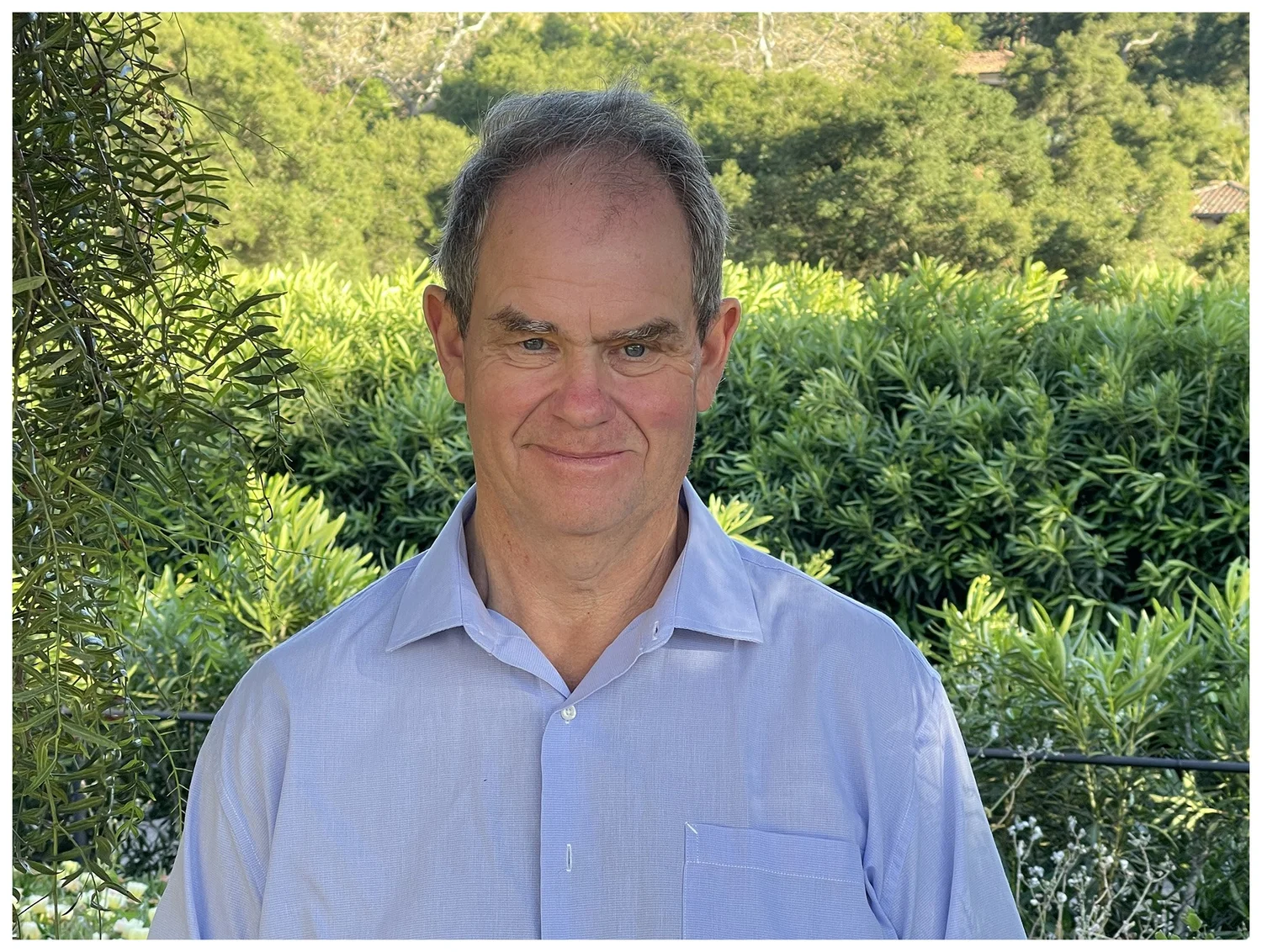
I have been a novelist for 25 years. Before that I was a barrister in London, specializing in criminal law. I emigrated to California in 2008 and love where I live with my wife, Tracy in Santa Barbara. We have two children, Nicholas and Anna. My grandfather was JRR Tolkien, and I am a director of his Estate. I have a wonderful pug called Sadie and enjoy our walks together, and playing tennis, golf, and watching TV dramas. I put everything I have into researching and writing my novels and trying to make them the best I can.
Theo’s journey takes him across continents and through ideological conflicts. How did you approach developing his moral compass?
The two novels, The Palace at the End of the Sea and The Room of Lost Steps, are a coming-of-age story in which the hero, Theo Sterling ages from eleven to nineteen, and journeys from hope to disillusionment, while learning many lessons about the world and himself. He is throughout concerned with trying to do what he considers to be right, inspired by the conviction that he can help to remedy injustice and change society for the better, so his moral compass is at the heart of both books. However, Theo’s problem is that he is young and strongly influenced by others, and their Utopian ideologies do not provide the solutions he had hoped for, but instead take him to dark places that test his faith in humanity and change his moral outlook and view of his place in the world.

Are there particular archival sources, diaries, or letters that proved invaluable during your research?
The novels ended up being a portrait of a decade – the turbulent Thirties – on both sides of the Atlantic, and the wealth of primary source materials meant that the research took longer than the writing! Nowhere was this truer than in relation to the Spanish Civil War itself. Theo volunteers to fight for the International Brigades against Franco’s Fascists and joins the American Lincoln Battalion. Many of the Lincolns died in Spain and at least fifty of those that returned wrote accounts of their experiences. Most of these books were long out of print, but I was able to order them from book depositories, and I read them all, sometimes more than once. They provided me with a vivid sense of what it was like to cross the Pyrenees by night, to go over the top, and to endure the horrors of trench warfare. I felt like an archaeologist digging down into the past, and I have tried to honour the memory of the brave Lincoln volunteers in The Room of Lost Steps.
Were there historical events or settings you considered but ultimately chose to leave out? Why?
The Room of Lost Steps ends in the fall of 1937, but the Spanish Civil War continued until the spring of 1939. I did not know until some way into the writing that I was only going to show six months of fighting, and I researched later battles as well as earlier ones. I finally decided to limit the book to the two battles of Jarama and Brunete because I concluded that ‘more war’ would diminish the impact of what I had already described.
I also considered writing a section set in the American-run Villa Paz military hospital where many of the Lincoln wounded were sent, and I read accounts written by the nurses and doctors who worked there. However, I ultimately decided not to use this material because a relationship between Theo and an American volunteer nurse wasn’t going to fit with the arc of his overall character development.
Your novels feature complex interweaving timelines. How did you plan the pacing across two books?
The novels are a coming-of-age story, and the action stays with Theo throughout, so that the timeline remains linear and chronological. Pace is always a concern, and certain years are passed over in only a few lines, whereas others became whole sections of the book. I tried to self-edit by looking at my writing through readers’ eyes and assessing whether the story would hold their attention.
The politics of the period and of Spain in particular, were complex and confusing, and I was constantly mindful that the book shouldn’t turn into a history lesson. My central aim as a historical fiction writer is to draw aside the veil of time and enable my readers to inhabit and experience the past, and this cannot happen if the author inserts himself into the narrative to provide ‘helpful’ explanations to the reader. I was guided by the idea that the reader should accompany Theo on his journey of exploration and discovery, so that what mattered to him should be included, and what was extraneous would be omitted.
The duology is not a thriller. The plot unfolds in the way it does because that is where the characters take it. My task was to make them interesting and real, so that the reader will care what happens to them, and that criterion dictates the pace of the writing.
Which character’s voice surprised you the most while writing the duology?
Esmond’s. He is the charismatic communist boy whom Theo meets at school in England. Theo falls under his spell and he has a profound effect on Theo’s decision-making both at the school and beyond. His personality is a contradiction, an enigma that Theo can never solve. He is far and away the funniest character in the books, but also the most serious. He is an ideological fanatic, and nothing can shake his loyalty to Stalin, but he also genuinely loves Theo and saves his life. And yet there is a coldness at his centre, an inability to empathise that Theo senses from the beginning. I couldn’t fully understand him myself, but he became as real to me as any of the characters I created, and I was never sure of what he was going to say or do next.
How do your experiences as a barrister influence your depiction of moral and ethical conflict?
Criminal law barristers don’t make moral judgments. Their task is to follow the client’s instructions: if he says he is not guilty, then the barrister must do all he can to secure an acquittal, regardless of the weight of the evidence. As a novelist, I also don’t judge because that would be to place myself between the reader and the fiction, thus undermining its immersive quality. Instead, I try to present multi-faceted characters whose relationships are placed under stress by unfolding events. It’s then for the reader to reach their own moral conclusions if they wish to do so.
The area where my legal training has had the greatest effect on my work as a novelist is in relation to organization and planning. The law made me a good researcher, able to separate the wheat from the chaff, and managing a complex brief has proved to be excellent training for developing the multi-layered narrative structure of an epic novel.
Can you share one book from another historical period that deeply influenced you as a writer?
How about two?
War and Peace helped me to understand the nature of war. Prince Andrei’s disillusionment with Napoleon amid the carnage of Austerlitz and his quest to find meaning in the face of suffering, affected the way I wrote about the First World War in No Man’s Land and the Spanish Civil War in the duology.
A Tale of Two Cities gave me a lasting sense of the visceral hysteria and terror of revolution, which is why I chose the famous first sentence of the book as a quotation with which to begin The Room of Lost Steps: “It was the best of times, it was the worst of times, it was the age of wisdom, it was the age of foolishness, it was the epoch of belief, it was the epoch of incredulity, it was the season of Light, it was the season of Darkness, it was the spring of hope, it was the winter of despair.” Dickens’s words perfectly sum up the extremity of the experience Theo underwent in Barcelona in the last two weeks of July 1936, a time that changed his life forever, and Sydney Carton’s courage was an inspiration for what I think is Theo’s most important and attractive character trait.
Is there anything else you would like to add?
Thank you for asking such stimulating questions. They made me think about the duology in new ways that I hadn’t considered before, which makes for a much more interesting written interview.
Thank you so much for taking the time to chat with me and share with my readers.
The Palace at the End of the Sea
By Simon Tolkien | Theo Sterling #1 | Goodreads
A young man comes of age and crosses continents in search of an identity—and a cause—at the dawn of the Spanish Civil War in a thrilling, timely, and emotional historical saga.
New York City, 1929. Young Theo Sterling’s world begins to unravel as the Great Depression exerts its icy grip. He finds it hard to relate to his His father, a Jewish self-made businessman, refuses to give up on the American dream, and his mother, a refugee from religious persecution in Mexico, holds fast to her Catholic faith. When disaster strikes the family, Theo must learn who he is. A charismatic school friend and a firebrand girl inspire him to believe he can fight Fascism and change the world, but each rebellion comes at a higher price, forcing Theo to question these ideologies too.
From New York’s Lower East Side to an English boarding school to an Andalusian village in the foothills of the Sierra Nevada, Theo’s harrowing journey from boy to man is set against a backdrop of societies torn apart from within, teetering on the edge of a terrible war to which Theo is compulsively drawn like a moth to a flame.
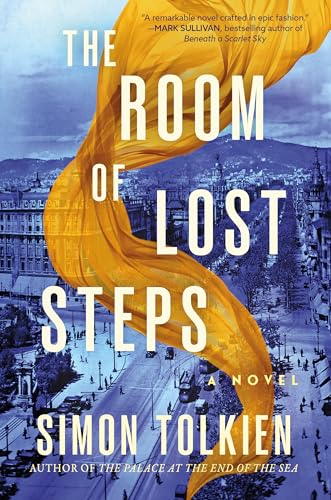
The Room of Lost Steps
By Simon Tolkien | Theo Sterling #2 | Goodreads
An American boy with impossible dreams is thrust into the cauldron of the Spanish Civil War in an arresting and thrilling historical coming-of-age epic by the author of The Palace at the End of the Sea.
Barcelona 1936. Theo helps the Anarchist workers defeat the army that is trying to overthrow the democratically elected government, and he is reunited with his true love, Maria. But all too soon, his joy turns to terror as the Anarchists turn on him, led by a rival for Maria’s affection.
Lucky to escape with his life, Theo returns to England to study at Oxford. But his heart is in Spain, now torn apart by a bloody civil war, and he is quick to abandon his new life when his old schoolmate Esmond offers him the chance to fight the Fascists. He is unprepared for the nightmare of war that crushes his spirit and his hope until, back in Barcelona, Theo is confronted with a final terrible choice that will define his life forever.
As Theo’s tumultuous coming-of-age journey reaches its end, can his dream to change the world—so far from home—still hold true?
Thanks for joining us for this interview! Connect with Simon on his website.
Many thanks to Over the river PR for connecting me with Simon. Check out the other hosts on the tour on this page.

Be First to Comment