Welcome friend! Today, I’m delighted to welcome Marisa Walz to talk about her debut novel, Good Intentions. At its heart, Good Intentions explores the complicated emotional terrain that follows tragedy. Through Cady, a luxury event planner grappling with the sudden loss of her identical twin, the novel examines how grief can reshape identity, blur boundaries, and draw us toward unexpected, maybe even unsettling, relationships.
In this interview, Marisa shares more about the inspiration behind her debut, her path to publication, and the emotional and psychological threads woven throughout this haunting story.
Good Intentions

A deft and immersive psychological suspense debut about a luxury party planner who becomes obsessed with a woman she encounters in a hospital waiting room.
Cady has worked hard to have a good life. She has a thriving luxury event-planning business, the man she’s loved since she was seventeen, and a social calendar she can barely keep up with. She also has Dana, her identical twin, her beyond best friend, her most trusted confidante. When Cady gets a call that Dana has been in a serious accident and arrives moments too late to say goodbye, her world falls apart.
But to Cady’s family’s growing concern and confusion, it’s not Dana’s death that consumes her. It’s Morgan, a grieving mother Cady encountered in the hospital waiting room, the day her sister died. It can’t be a coincidence, that they both experienced tragedy at the same moment, in the same place—Cady doesn’t believe in coincidences. Instead, she is convinced that she must help this stranger overcome her tragedy, in order to come to terms with her own.
Or…is there more to it? Is it possible that Cady wants something else from Morgan? Something she can’t even admit to herself?
Slyly twisted and deeply provocative, Good Intentions captures the moral ambiguity that can arise in the face of impossible choices. Like the aftermath of a car accident—and against your better judgment—you won’t be able to look away.
Get to know the author: Marisa Walz
Hi Marisa! Welcome to Armed with A Book. It is a pleasure to chat with you. Please tell me and my readers a bit about yourself.
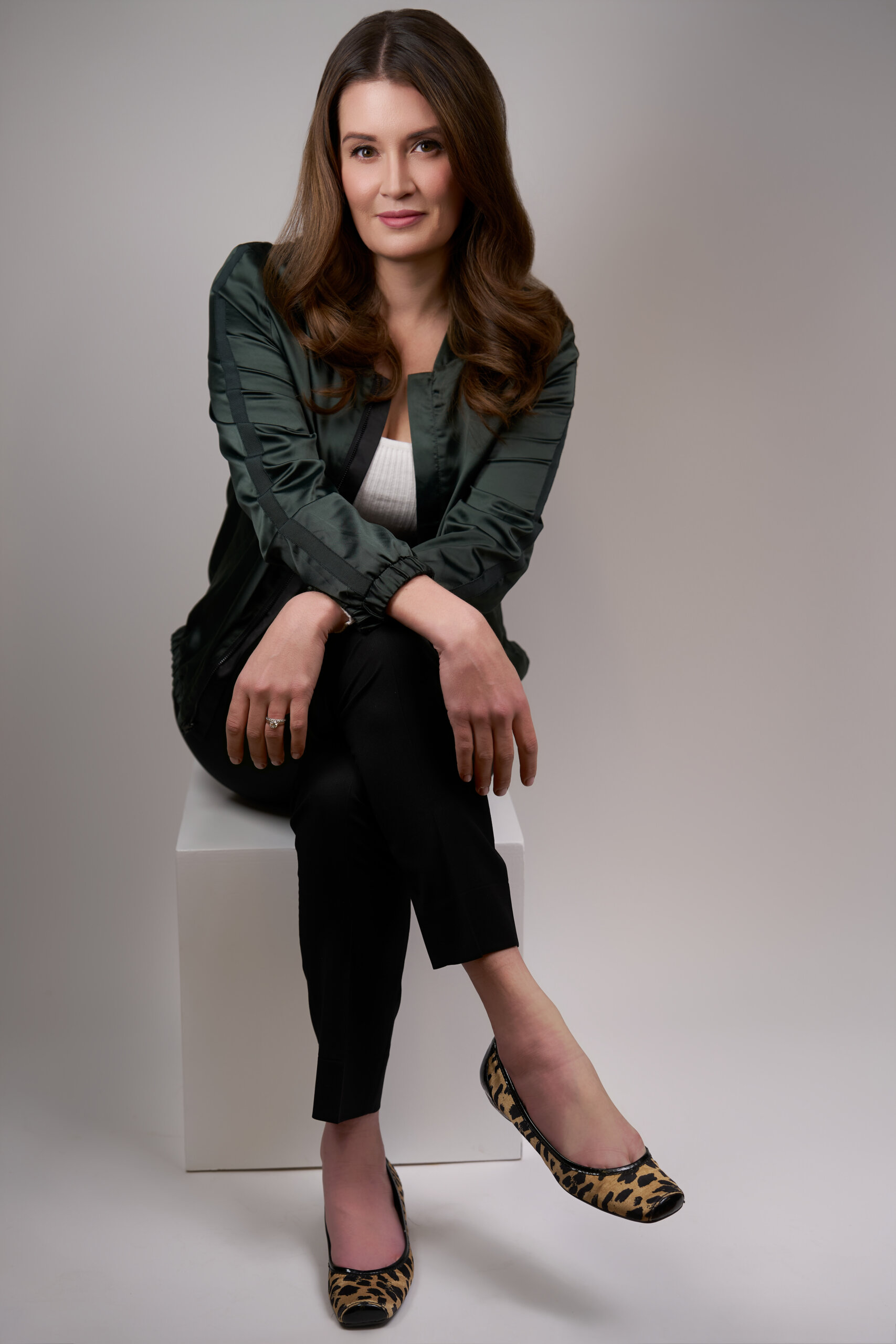
Hi! So thrilled to be talking about Good Intentions with you. It’s my debut novel, but definitely not the first I’ve written. I’ve wanted to be an author since I was seven years old, and I’ve been writing seriously for the past ten years. I work in banking by day, but in every spare moment I’m writing twisted, nefarious stories.
You describe yourself as someone who writes about “people behaving badly.” What draws you to moral messiness rather than neat, likable characters?
I find neat, likeable characters a little boring—and honestly, not very relatable. Real people are messy. We justify things we shouldn’t, make choices we don’t fully understand, and are full of contradictions we’d rather not examine. I’m drawn to characters who force me to take a hard look at myself, to sit with uncomfortable questions, and to stretch my capacity for empathy. Moral messiness is where the most honest, and most interesting, stories are found.
Cady and Morgan connect instantly in a hospital waiting room—an emotionally charged, liminal space. What made that first meeting feel inevitable to you as the starting point for this story?
I needed Cady and Morgan to meet in a way that would feel instantly binding, even if that bond is initially more one-sided on Cady’s part. Because grief is the glue between them, the hospital felt inevitable—and specifically the waiting room. It’s such a liminal space; everyone is suspended in the same uneasy uncertainty. Whenever I’m in a hospital waiting room, I find myself studying the people around me, wondering what brought them there, knowing that probably none of us woke up expecting to be there that day. That shared vulnerability creates a kind of intimacy that felt like the perfect—and dangerous—place for their connection to begin.
Dana was Cady’s identical twin and her emotional anchor. How did Dana’s personality and life path contrast with Cady’s, and how did that contrast shape Cady’s sense of self?
There are so many stories out there about how similar twins are, even if they grow up in completely different environments. But given Cady’s extreme personality, I thought it would be likely that Dana would push back on, rather than lean into, Cady’s intensity (which is how Cady and her family euphemize her, ahem, darker impulses in the novel). That distancing becomes foundational to Cady’s sense of self. Any separation feels like abandonment to her, so any act of independence on Dana’s part isn’t just painful, it’s destabilizing. Losing Dana doesn’t just mean losing her twin; it means losing the person who anchored and defined her, which accelerates Cady’s spiral in ways that created so many avenues for me to explore.
People grieve in very different ways, and Cady’s grief manifests as intense focus on someone else’s loss. Why is Morgan so compelling to Cady in that moment?
A couple things: one, right off the bat, when Dana dies, Cady believes that no one can truly understand the pain of losing a twin—except, perhaps, a mother. There’s a line in the book about losing a literal, physical piece of yourself when you lose a twin or a child, and that belief shapes how she views Morgan from the start.
The other reason I think Cady latches onto Morgan so instantly is that she feels an immediate need to somehow replace Dana. She knows, intellectually, that no one can replace Dana—she even says this to her husband—but grief doesn’t operate on logic. Morgan resembles Dana just enough, and carries a similar vulnerability, to trigger Cady’s need to fill that void. And crucially, Morgan feels influenceable in a way that’s familiar to Cady.
The novel asks readers to sit with discomfort and ambiguity. What conversations about grief did you hope this story would spark?
Mainly, I was testing the reader’s capacity for empathy. Admittedly, I really pushed the limits here, writing Cady the way I did. But I don’t think it’s very impressive to be able to empathize with a character who’s perfect or whose “flaw” is something silly, like being a perfectionist or having a hard time talking about their feelings—yawn. What I hoped the book would spark were conversations about where we draw the line with our compassion: who we’re willing to extend it to, and under what circumstances. If someone is in an unbearable situation, carrying unresolved issues, and then behaves badly, is there still room to understand them—even if we don’t excuse them?
Luxury event planning is such a fascinating profession—controlled, curated, image-driven. Why was this the right career for Cady?
Good Intentions is a heavy book—it’s not just disturbing, it’s deeply sad—so I leaned on glamour and moments of humor to give readers pockets of relief. Luxury event planning made sense for Cady because it offers prestige and extreme pressure. She thrives on impossible standards, on control, on creating something flawless. That kind of work validates and fulfills her. It also mirrors the novel’s larger concerns: image versus reality, what’s carefully curated versus what’s quietly unraveling. For a long time, Cady’s job keeps her out of trouble. Until, of course, it doesn’t.
If you could give Cady one piece of advice—knowing she might not take it—what would it be?
I would never dare try to give Cady any advice!
Did you have particular scenes or moments that felt especially hard—or especially satisfying—to write?
The twist at the end was very difficult to write because it’s just so heartbreaking.
As a debut author, what has surprised you most about the publishing process so far?
Hands down, people. There are so many horror stories out there about heartless publishers and jealous fellow authors and unsupportive friends and family—but that has not been my experience at all. My publishing team has been super supportive, kind, and patient at every stage of the process.
A whole new world of friends has been opened up to me through other authors, booksellers, and book influencers—truly the greatest community of people on earth. And my friends and family have shown up in ways I’ll never forget, either: asking about the book, preordering it, telling everyone they know, and coming out to support me at launches and tour stops. That level of support—from everyone—has been the most unexpected, and most meaningful, part of this whole journey.
What’s one thing you’ve learned during this debut journey that you know will serve you well as you work on your next book?
Keep writing the books you want to read. The moment you start trying to please a specific person, trend, or imagined reader, you lose the thread—and you’ll never truly win that battle anyway. The most important thing I’ve learned is to trust what lights a fire in my belly, write the story that feels urgent and alive to me, and then trust that the right readers will find it.
Your teen years were spent running e-zines and absorbing Cosmo- and Seventeen-style advice. How did that early internet writing life shape the writer you are today?
Spending my teen years running e-zines and devouring Cosmo- and Seventeen-style advice taught me to think about storytelling in many different ways. Consuming so many types of media trained me to write across formats and voices—and it’s been incredibly useful for my second novel, where I’ve leaned heavily on interstitials to tell the story in a more immersive, interesting way.
Finally, when readers finish Good Intentions, what do you hope they’re still thinking about hours—or days—later?
I wrote Good Intentions hoping readers would asking themselves whether good people can do bad things—but more than that, I wanted them to leave the book with questions, not answers. The point was never to teach a moral; it was to unsettle and provoke and linger. My favorite reviews are the ones where readers say they’re still thinking about the ending days later—or that it’s going to take them a while to recover.
Is there anything else you would like to add?
Nothing I can think of—these were great questions, thank you!
Thank you so much for taking the time to chat with me!
Thank you for reaching out!
Thank you, reader, for joining us! Add this book on Goodreads.Good Intentions is now available wherever books are sold! Be sure to check your local library too.
Many thanks to the publisher for the review copy and Katie B. for the interview opportunity! Stay tuned for my review! 🙂

Be First to Comment