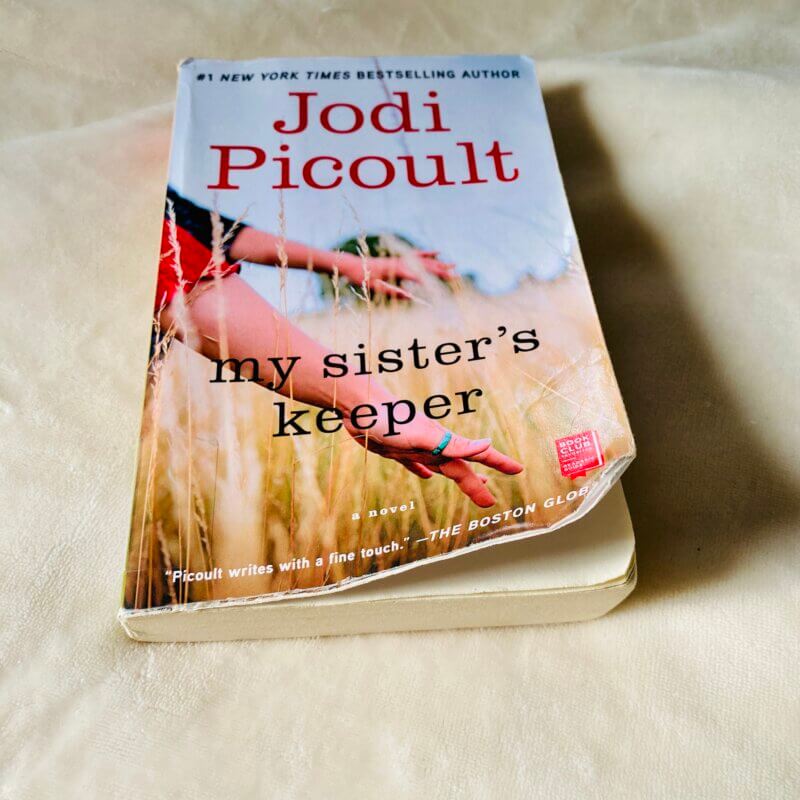
Welcome friend! My Sister’s Keeper is a book I first read over a decade ago, and revisiting it now felt like returning to familiar terrain with a completely different map. The story follows a family whose eldest daughter, Kate, has a rare form of leukemia. Her younger sister, Anna, was conceived to be a perfect genetic donor — a single procedure that turned into thirteen years of repeated medical contributions to keep Kate alive. When Anna sues her parents for medical emancipation, the fragile foundation of their family splinters, forcing each of them to confront love, autonomy, and the unspoken expectations that have held them together.
In classic Jodi Picoult style, My Sister’s Keeper weaves courtroom drama with intimate family turmoil. Through multiple perspectives, the novel examines what it truly means to parent, protect, and love a child who may not live long — and what it costs the siblings asked to orbit the pain. It’s a story layered with moral complexity and emotional honesty, made even richer on a reread.

Jodi Picoult | Goodreads
New York Times best-selling author Jodi Picoult is widely acclaimed for her keen insights into the hearts and minds of real people. Now she tells the emotionally riveting story of a family torn apart by conflicting needs and a passionate love that triumphs over human weakness.
Anna is not sick, but she might as well be. By age 13 she has undergone countless surgeries, transfusions, and shots so that her older sister, Kate, can somehow fight the leukemia that has plagued her since childhood. The product of preimplantation genetic diagnosis, Anna was conceived as a bone marrow match for Kate—a life and a role that she has never challenged … until now. Like most teenagers, Anna is beginning to question who she truly is. But unlike most teenagers, she has always been defined in terms of her sister—and so Anna makes a decision that for most would be unthinkable, a decision that will tear her family apart and have perhaps fatal consequences for the sister she loves.
My Sister’s Keeper examines what it means to be a good parent, a good sister, a good person. Is it morally correct to do whatever it takes to save a child’s life, even if that means infringing upon the rights of another? Is it worth trying to discover who you really are if that quest makes you like yourself less? Should you follow your own heart or let others lead you? Once again, in My Sister’s Keeper, Jodi Picoult tackles a controversial real-life subject with grace, wisdom, and sensitivity.
My Sister’s Keeper – Review
My Sister’s Keeper by Jodi Picoult remains one of those novels that changes meaning as your life changes. When I first read it, I understood it intellectually; rereading it as a mother reshaped the entire emotional landscape of the book. What once felt like page-turning drama now felt like a lived experience — the guilt, the fear, the impossible choices, the question of who a child is outside the roles they play in a family. Following the deep dive into library holds of Jodi Picoult’s books, I got a copy of this well-loved novel and decided to give it a reread. It was amazing to fall back into a familiar book through brand new eyes.
Motherhood Revisited: Seeing Sara Through New Eyes
When I first read Sara, she was just a character. I don’t remember her being a likeable character in my first read, though I did sympathize with her and the tough set of cards she had been dealt in life. In my reread, she felt painfully real. I understood her instincts better though I still found her choices heartbreaking.
Her entire life pivots on a small moment: her toddler handing her crushed flowers. It’s a mundane gesture, but one that cracks open her priorities. She was an attorney. She had ambitions. But motherhood rearranged her world. At the time of writing this review, I hadn’t returned to work yet but I had been handed a toy by my baby. I know the work I loved will never matter as much as she does to me. Unlike Sara, I cannot become a stay at home mom, but I can still learn to cherish the precious moments of watching my daughter grow. She broke me open as well.
Mom Guilt and the Weight of Responsibility
This reread revived many early motherhood moments for me. Years ago, I breezed past many of the firsts that this book mentions. I now understand the pride when a baby rolls over. The constant tension of sickness. The guilt when consoling one child while another is struggling. The mind’s desperate attempt to blame us for everything that happens to our kids.
I chose to start my daughter in daycare before I returned to work. My mom encouraged me to start her two months in advance to have lots of time for her to adjust to new routines, go through some waves of sickness that daycare brings and have some time to enjoy for myself. The first two weeks, enjoyment felt impossible. What had I done handing over my baby to strangers while I could get some time away? In conversations with friends, I came to realise that mom guilt is not a sign that I’m doing something wrong. It’s a sign that I care deeply. As a mother, it is so common to hold dual contradictory emotions. I love being with my daughter and treasure our time together. I also want her to be confident, social, adaptable, and nurtured by a wider world. Those truths don’t oppose each other — but guilt makes them look like they do.
The same is true for Sara. She loves both Anna and Kate and wants them both to have long healthy lives. Though it may look like she is making choices that prefers Kate over Anna, in all other ways, she is doing all she can to help Anna thrive. A child that challenges the parents on such a key issue as her medical autonomy is one who has learned well from her parents to not shy away from tough questions.
Brian’s Quiet Steadiness: The Father Who Holds Space
I enjoyed Brian’s chapters in the first read but this time they hit differently too. His astronomy hobby becomes a gentle refuge for him and for the kids. This is a reminder that the world is bigger than the crises holding a family hostage and we can find moments of connection.
His perspective adds compassion to the narrative. While Sara is laser-focused on Kate, Brian holds space for Anna.
He is a firefighter by trade and has a community in his colleagues. The firefighter’s code — “The safety of the rescuer is a higher priority than the safety of the victim.” — is tragic wisdom and I pondered Kate (victim) and Anna (rescuer) in this relationship. In the courtroom, Sara offered another side of this:
“If you’re a parent and the person in the building is your child, not only would everyone understand if you ran in… they’d expect it.”
My Sister’s Keeper is full of such emotional bombs that made me think of the situation from multiple angles.
Anna: A Child Seen Only Through Her Sister
Anna’s perspective continues to be heartbreaking. She knows the world is bigger than her parents. Bigger than Kate. Bigger than the identity she’s been assigned. She wants the innocence of the past, but she can’t continue living only in relation to her sister.
One of the strongest themes emerges here:
“Traditionally, parents make decisions for a child… But if they are blinded by the best interests of another one of their children, the system breaks down.”
The courtroom scene between Campbell and Sara underlines this painfully. Every question about Anna becomes an answer about Kate. I find this scene unforgettable. Sara’s inability to keep Anna as the focus shows how she is not able to make decisions by considering Anna as an individual first and helps bolster the case for Anna. But, the situation arises because Kate is sick. Can a parent even be expected to be logical about this? The deep intertwining and tangle of family life has never been more obvious. There are no right answers here.
I am reminded of Sarah Blondin’s book, Heart Minded: How to hold yourself and others in love:
“your entire life was choices, made one after another in the name of love, or preserving that love. Nothing will be wrong or broken, just choices made, either way in the name of your heart.”
No matter what her choices look like, Sara has always made them from a place of love for her family.
Family: Fractured and Surviving
Despite the disagreements, the heartbreak, and the ethical wreckage, Brian and Sara survive as a family unit. The novel never lets them be perfect — only human.
Having read the book before, I know how it ends and the pages of grief still met me before I closed this book.
“As much as you want to hold on to the bitter sore memory… you are still in the world, and living is a tide.”
This may be one of the truest lines in the novel. Grief reshapes you slowly, until one day you look down and realize how you’ve been changed. No matter how tough it is, we keep going. We keep surviving. Not always at our best, our loved ones accept us at our worst and keep believing in us.
A Final Reflection
One line stayed with me more deeply than any other:
“We never have children, we receive them.”
This time, that truth felt expansive. Parenting is stewardship, not possession. And sometimes the time we have is shorter than we’d ever imagine — but still, infinitely better than not having it at all. Some months ago, one of my author friend’s daughter’s turned one year old. She said how she could not remember what life used to be before she had her child.
As my daughter herself nears this milestone and my first year of motherhood draws to a close, I understand this sentiment. My life is enriched even more with her – I see it in the ideas I want to explore through writing and blogging, the thoughts I have, and the books I read. A reread like this starkly shows how much my world has expanded. Like Sara and Brian, it’s not been easy but it’s definitely been a time of making beautiful memories, inspite of the hardships.
Thank you for spending time with my reflection on My Sister’s Keeper. This reread brought new layers of meaning into focus for me, especially as I near the end of my first year of motherhood.
If you’ve read the book — whether recently or long ago — I’d love to hear how it landed for you. Has its meaning shifted for you over time?
If you enjoy Jodi Picoult, take a look at my article: Which Jodi Picoult Books Are Readers Still Checking Out? A Library Deep Dive
Thank you for being here! ❤️

I was going to say this feels like a blast from the past! I remember when it seemed like everyone was reading this!
Yes! This book was quite popular, especially when the movie came out.