
Welcome friend! When I read Djinn Patrol on the Purple Line back in 2020, I was struck by how deeply personal it felt. Growing up in India, crime shows were a constant presence in the background of daily life—equal parts entertainment and escape. So when Jai, a nine-year-old boy obsessed with detective stories, set out to solve the disappearance of his friend, I followed him eagerly into a world that felt both familiar and unsettlingly real.
Deepa Anappara has a gift for weaving suspense with social insight, illuminating the lives of children and communities that are often overlooked. Whether exploring the fragile bonds of a neighborhood or the systems that fail them, her writing is immersive, sharp, and deeply compassionate.
Now, with The Last of Earth, Deepa once again invites readers into a layered, thought-provoking narrative—one that asks urgent questions about power, belonging, and survival. I’m delighted to welcome her to the blog to talk about storytelling, community, and the truths that anchor her work.
The Last of Earth

From the award-winning author of Djinn Patrol on the Purple Line comes a stunning historical novel set in nineteenth-century Tibet that follows two outsiders—an Indian schoolteacher spying for the British Empire and an English “lady” explorer—as they venture into a forbidden kingdom.
1869. Tibet is closed to Europeans, an infuriating obstruction for the rap¬idly expanding British Empire. In response, Britain begins training Indians—permitted to cross borders that white men may not—to undertake illicit, dangerous surveying expeditions into Tibet.
Balram is one such surveyor-spy, an Indian schoolteacher who, for several years, has worked for the British, often alongside his dearest friend, Gyan. But Gyan went missing on his last expedition and is rumored to be imprisoned within Tibet. Desperate to rescue his friend, Balram agrees to guide an English captain on a foolhardy mission: After years of paying others to do the exploring, the captain, disguised as a monk, wants to personally chart a river that runs through southern Tibet. Their path will cross fatefully with that of another Westerner in disguise, fifty-year-old Katherine. Denied a fellowship in the all-male Royal Geographical Society in London, she intends to be the first European woman to reach Lhasa.
As Balram and Katherine make their way into Tibet, they will face storms and bandits, snow leopards and soldiers, fevers and frostbite. What’s more, they will have to battle their own doubts, ambitions, grief, and pasts in order to survive the treacherous landscape.
A polyphonic novel about the various ways humans try to leave a mark on the world—from the enduring nature of family and friendship to the egomania and obsessions of the colonial enterprise—The Last of Earth confirms Deepa Anappara as one of our greatest and most ambitious storytellers.
Get to know the author: Deepa Anaparra
Hi Deepa! It’s such a pleasure to have you on Armed with A Book. Please tell me and my readers a bit about yourself.
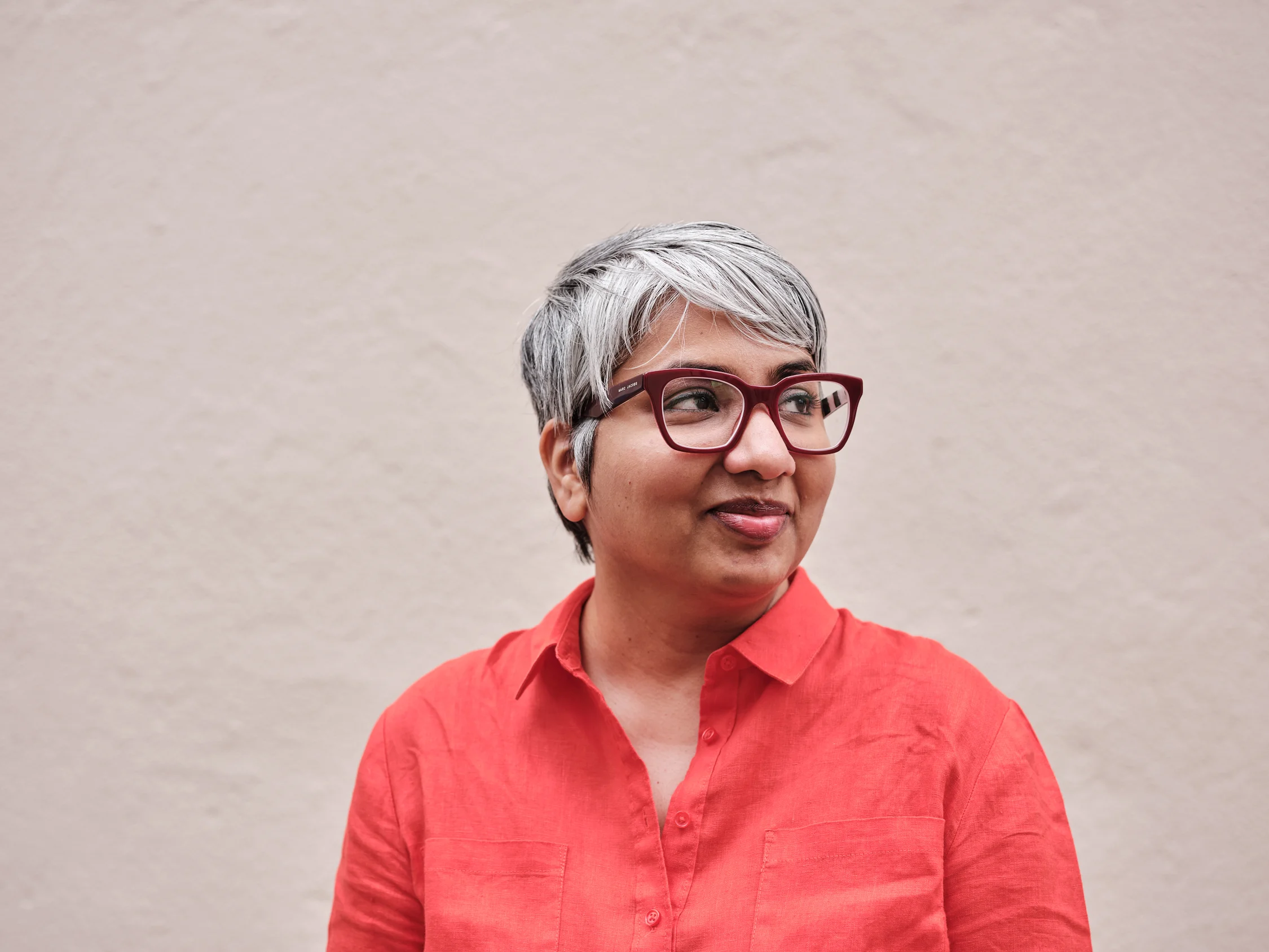
Thanks for this interview, Kriti. I grew up in India and worked as a journalist there for several years before moving to the UK, where I started writing fiction. I studied creative writing and teach writing too, and I also co-edited a collection of personal essays on writing fiction as interpreted through the lenses of race and culture, titled Letters to a Writer of Color (2023).
I read Djinn Patrol on the Purple Line when it first released in 2020. Tell me about the writer you were then—and how you feel you’ve grown or shifted in the years since.
For me, facing the blank page feels pretty much the same. There is still apprehension and excitement. The attempt to describe the fictional world in a way that feels like a close approximation to reality, through the character’s eyes, also feels the same. I may have more awareness of writing techniques now, but I am not really thinking of all that while writing.
The Last of Earth is set in a completely different time and place. What sparked the transition from contemporary India to 19th-century Tibet?
The story is filtered through a primarily Indian lens in that both narrators were born in India (though Katherine, the female narrator, identifies as British). I see this story as being part of Indian and British history. It is based on true stories of British officials who tried to gain a foothold in Tibet by sending Indians to spy on the region. Both Djinn Patrol on the Purple Line and The Last of Earth have similar concerns: excavating the voices of those marginalized or erased by society and history and the mainstream discourse.
As both a journalist and novelist, you’ve had access to countless real stories. What specifically drew you to 1869 Tibet and the Indian surveyors working undercover for the British?
I have always been fascinated by Tibet, since I was a child, but the impetus for this novel came from my experiences after moving to the UK. I found that there was not much discussion of colonialism or the British Empire and, in fact, the Empire is still seen by many people in Britain as something to be proud of. When I chanced upon the true stories of Indians who risked their lives for the British by spying on Tibet, and conducted secret mapping expeditions there, I wondered what had prompted them to undertake these risks. The novel is essentially my attempt to answer that question as to why certain Indians accepted that they were second-class citizens in their own country, and tried to align with a colonial power. I also wondered whether there was a disruption in that power dynamic during an expedition because then the British explorer would have been at the mercy of the Indians who carried his belongings and guided him around Tibet.
Balram and Katherine come from very different worlds, yet they share a kind of outsiderhood. What did you enjoy most about writing their intersecting journeys?
You are right that they are both outsiders in their own ways, and that was the best part of writing these characters who don’t quite belong anywhere and perhaps feel more at ease in movement, as during an expedition.
Balram’s search for Gyan adds emotional urgency to the story. How did their friendship shape the heart of the novel?
Balram’s chapters are mostly focused on his search for Gyan. What their relationship, and the changes in their relationship, signify, is a microcosm of what would have been happening across India under British rule, in that colonialism impacts the home, or the domestic sphere, and not just the country’s economy or national identity. The changes in the close relationship that Balram has with Gyan as they work for a colonial power does shape the trajectory of the novel.
Katherine is determined to reach Lhasa despite the odds stacked against her. What inspired her character?
Katherine is based on women explorers of that time, some of whom travelled to Tibet to spread Christianity or because they were interested in Buddhism or wanted the adventure. She is drawn from the real-life stories of female explorers from the 19th and early 20th centuries. I thought it was fascinating that these women could travel to Tibet when their lives were severely constrained by society; even the clothes they typically wore—the corsets or long skirts, for instance—wouldn’t have allowed them to climb a mountain. But that didn’t stop them.
There is so much sensory worldbuilding—snow, silence, fear, altitude. What kind of research went into capturing Tibet’s landscape so vividly?
I read a lot of books about Tibet, particularly accounts by 19th century travellers to Tibet to understand what the landscape would have looked like then. I also travelled to Tibet, and seeing the region with my own eyes was invaluable.
How do you navigate the tension between historical accuracy and the emotional truth required for fiction?
I don’t see that as separate; the setting, the rules and standards of that time, would have motivated the actions of characters. For instance, they would have been guided by faith, and the supernatural, in a way that many people today would find alien.
As long as I understand the setting well, I can write the interior of characters in a way that feels both authentic to them and the time (or so I hope!).
Many overlooked Indian figures played vital roles in colonial-era exploration. What did you discover about these surveyor-spies that stayed with you?
I learnt that the routes they charted by using their own bodies as surveying instruments—measuring miles by the number of paces taken, for instance—were accurate and match most of the distances we have calculated today with our modern instruments. The physical demands they placed on themselves to undertake these expeditions for the colonizer were strenuous and remarkable; the book was one way to understand their motivations.
If you could travel to any historical period for research (with safety magically guaranteed!), where would you choose?
Great question. I would have loved to be in 19th-century Tibet for sure though I will be happy with another journey back there even today. I am also fascinated by the Mughals in India and particularly the Mughal emperor Shah Jahan who constructed the Taj Mahal in Agra in the 17th century. I would love to be there at that time, watching the decision-makers and those whose hands actually built the monument.
What do you hope readers carry with them long after finishing The Last of Earth?
The Last of Earth is meant to be an adventure novel that subverts the tropes of the genre, so I hope it makes readers think about cartography and exploration in a new way.
Thank you so much for taking the time to chat with me! It is lovely to connect with you on The Last of Earth.
Thanks for the great questions!
Thank you, reader, for joining us! Add this book on Goodreads.The Last of Earth is now available wherever books are sold! Be sure to check your local library too.
Many thanks to the publisher for the review copy and Sophie Z. at Wunderkind PR for the interview opportunity! Stay tuned for my review! 🙂

Be First to Comment