Welcome, friend! It’s Halloween week and what better way to celebrate than with haunted houses, ghost stories, and local legends? Today, I’m thrilled to welcome Bram Stoker Award–winner Christa Carmen, whose latest novel How to Fake a Haunting promises to deliver chills, thrills, and more than a few surprises. Set in haunted New England, it’s the perfect read for anyone who loves their horror with a clever twist. Here is a look at what the book is about and then let’s welcome Christa and chat with her! I loved this interview and I think you will enjoy it too. 🙂
How to Fake a Haunting

A desperate woman’s plot to frighten her husband out of her life takes a nightmarish turn in a chilling novel of modern horror by a Bram Stoker Award–winning author.
Lainey Taylor is being pushed to the brink by her alcoholic husband, Callum. Prone to hallucinations and erratic behavior, it’s only a matter of time before he puts Lainey’s life—and that of their daughter, Beatrix—in jeopardy. A divorce and full custody is out of the question. In Callum’s words: Over my dead body.
Lainey’s sympathetic friend Adelaide has a wild solution. They’ll stage a haunting so convincing it will drive Callum out of Lainey’s life for good. Nothing too over the top: strange smells, noises in the walls, and flies unleashed along the windowsills. It could work. Considering Callum’s alcohol-induced night terrors, he’s already close to broken. With each new scare, Lainey is closer to seeing the haunting through to its bitter, freeing end.
But in a house filled with so much rage, resentment, and fear, is it any wonder that Lainey and Adelaide’s plan goes horribly wrong? As their fake haunting spirals into something no one can control, Lainey discover
Get to know the author: Christa Carmen
Hi Christa! It’s such a pleasure to have you on Armed with a Book. To start us off, can you tell my readers a little about yourself?
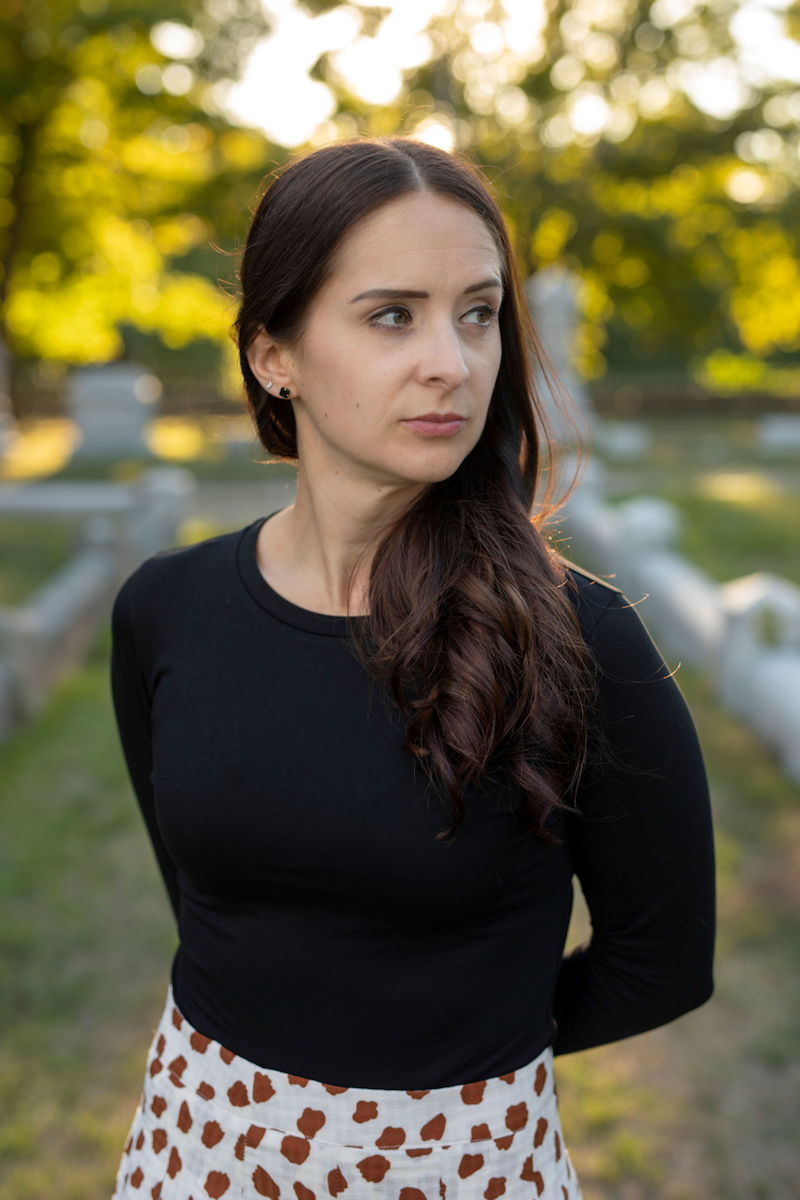
I live in Rhode Island and am the author of How to Fake a Haunting, Beneath the Poet’s House, and The Daughters of Block Island, which won the Bram Stoker Award for Superior Achievement in a First Novel and was a Shirley Jackson Award finalist, as well as the Indie Horror Book Award-winning Something Borrowed, Something Blood-Soaked, and the Bram Stoker Award-nominated “Through the Looking Glass and Straight into Hell” (Orphans of Bliss: Tales of Addiction Horror). I have a BA from the University of Pennsylvania, an MA from Boston College, and an MFA from the University of Southern Maine.
When I’m not writing, I keep chickens and like to set out on adventures with my husband, daughter, and bloodhound-golden retriever mix. Most of my work comes from gazing upon the ghosts of the past or else into the dark corners of nature, those places where whorls of bark become owl eyes, and deer step through tunnels of hanging leaves and creeping briars only to disappear.
How to Fake a Haunting is such a perfect October title. What inspired this story, and how did you decide to set it in New England?
There was a very specific moment of inception for this book. My husband and I have been married for nine years this October, and like all married couples (or maybe just like all people once they reach a certain age), we tend to occasionally (ahem, often) spend so much time choosing a movie to watch, that by the time we turn it on, one or both of us falls asleep. On this particular evening, my husband swore he wasn’t tired; we chose a movie, and not five minutes later, I heard heaving breathing coming from the couch.
Annoyed, I decided to head in and get ready for bed. But before I could, an idea–BAM–hit me like a horror movie jump scare. I grabbed his cell phone, and took a picture of him sleeping on the couch. I think maybe I was planning to show him the picture in the morning, like, “I told you you’d be the one to fall asleep!” Instead, I texted the picture to myself, walked into the kitchen, and then stormed back into the living room loud enough to wake him. “Why did you just text me a picture of yourself sleeping?” I asked. Disoriented, he replied, “What? Why would I text you a picture of myself sleeping?” But I doubled down, narrowed my eyes, and said, really cryptically, “You mean, you didn’t just text me this picture of you sleeping from your phone?” Needless to say, he was suitably freaked out, and eventually, I caved and admitted to the prank. When the time came to get working on a new novel, I thought of the playfulness of scaring your spouse, and how the idea of faking a haunting could be really fun, which morphed into questions of why someone would want to commit to a fake haunting, and then things just took off from there!
I think my consistent use of Rhode Island as setting can be attributed to a combination of two factors. First, there is absolutely something haunted and horrific about the smallest state in America. Especially in the beach communities at the southern part of the state, there’s such a sense of isolation in the winter, of things lurking in the cold and waiting to awaken. Additionally, while I don’t necessarily subscribe to the oft-repeated “write what you know” adage, I find that setting a work of fiction in a place with which you are intimately familiar makes for fiction that can be more dynamic to read, and more enjoyable to write.
The line between “real” and “fake” hauntings is such a fun gray area. As a horror writer, how do you blur that boundary for readers?
What draws me to horror and hauntings in the first place is the ability for writers to examine a difficult topic—be it mental illness, addiction, trauma, loss, guilt, regret, shame, etc.—through the lens of something even more terrible, more disturbing, and more soul-splitting, resulting in a piece of art that—in addition to horrifying the reader—can entertain, teach, promote empathy, and even heal. Not too many other genres, if any, can claim that blurring of boundaries, and it’s that manifestation of meaning through horror that I feel creates an emotional connection with readers in both satisfying and organic ways.
With How to Fake a Haunting specifically, I wanted to tell a story that felt like the inverse of “setting influencing narrative”; what if wasn’t the past or bad bones that caused a house to be haunted but bad guts, what it consumed, what lived within it… inhabitants that were parasites of sorts, transforming the constitution of their host? I wanted to set this story in the vicinity of the Gilded Age Newport Mansions, those opulent buildings that feel like they should be haunted, based on their rich and occasionally scandalous histories. A haunting, whether real or fake, feels fresher and more fun when it takes place at a home only recently built.
New England is full of ghost stories and folklore—were there particular local legends that found their way into your novel?
Not this novel specifically, but six years ago, when I was pregnant with my daughter, my mother reminded me that she and my father had been saving boxes and boxes of books in their basement for when I had my first child. I found the requisite baby books, the chapter book series (Goosebumps, Bunnicula, Baby-Sitters Club, Nancy Drew), but I also found something else of interest: a book of Rhode Island legends and folklore in pristine condition, signed and personalized for me by the author. Flipping further into the book, I found that the first chapter was dedicated to Mercy Brown. For anyone unfamiliar with Mercy Brown, she was the last person exhumed in New England after death in the name of vampirism. Put plainly, she was dug up a few months after her death, and her heart and other organs were examined in hopes of naming her the “offending corpse,” an undead soul that would rise from the grave to drain the life force of others in the community, in this case, her brother, Edwin. Interestingly enough, Mercy Brown was the subject of the novel with which I acquired my lovely agent, and I remain fascinated by her to this day (I guess it’s no surprise I kept that childhood book!).
There are countless other legends and ghost stories of Rhode Island that have interested me enough to write about, including Dolly Cole, in my short story “The Circle,” included in the Shirley Jackson Award-nominated anthology, Monsters in the Mills, and Sarah Helen Whitman (a historical figure, but someone about whom ghost stories abound) in my second novel, Beneath the Poet’s House.
Your background includes award-winning horror fiction. How did writing How to Fake a Haunting differ from your earlier work?
How to Fake a Haunting came on the heels of my two other books that are set in Rhode Island. The Daughters of Block Island takes place at White Hall on Block Island, and Beneath the Poet’s House is set at 88 Benefit Street in Providence, which was the home of Sarah Helen Whitman, onetime fiancé of Edgar Allan Poe. Like I mentioned earlier, with How to Fake a Haunting, I wanted to tell a story that wasn’t influenced by the setting but only by the characters. For a while, while working on the first draft, I wasn’t even certain the book HAD to take place in Rhode Island… it felt like I could pick the action up and plop it down anywhere, and that was an entirely new experience for me!
Ultimately, I ended up backdropping the book against the Newport mansions, with the two main characters working for the Preservation Society of Newport Country, and these decisions helped a few more elements of the story fall into place!
If someone new to your writing picked up this book first, what would you want them to know about your style?
I watch a lot of horror movies, and I try to write scenes—at least, suspenseful ones—the way I like to see them on a screen: quick decisions from characters, an absence of extraneous detail, focus on the five senses, and crisp, succinct descriptions of action.
Beyond suspenseful, action-driven scenes, I would like to think my style is a mixture of tight pacing and quieter, more drawn-out descriptions of atmospheric setting and character interactions. I aim for the style of Shirley Jackson meets Ruth Ware… literary horror, characters on the edge, and stakes-driven narratives. Whether or not I achieve that is up to the reader to decide.
Do you believe in ghosts yourself—or do you lean towards the “fake haunting” side of things?
I’m the worst kind of horror writer… one who does not believe in ghosts! I guess I shouldn’t say I don’t believe, I’ve just never experienced anything supernatural. I’m open to being proven wrong, however! Not just open, willing! Suffice it to say, a Ouija board to me is little more than a cool conversation starter or fun piece of home decor. There are others in my house (ahem, my husband!) who don’t share my opinion of Ouija boards, however, so my spirit board ownership is limited to a Ouija cheese board. It’s quite adorable, if I do say so myself, and none of the cheese has ever levitated and flown off, so I suppose it can’t be too haunted.
I love the idea of ghosts representing things: secrets, the past, regrets, future selves, past selves. I also love the idea of hauntings going in both directions: Can your future self haunt your current self? Can your past self haunt your future self? Can your current self haunt your past? I think all these directions of self-hauntings are possible, so maybe a Ouija board is incidental, and the most haunted object one can own is… a mirror. Certainly the characters in How to Fake a Haunting would agree.
Have you ever had a real-life spooky experience that gave you chills?
See my answer to above…unfortunately, I never have!
Although… I guess I’ll take this opportunity to say that I have had experiences that maybe someone else might consider, if not supernatural then at least… uncanny? I occasionally wake up at night and cannot fall back to sleep only to find out in the morning that a loved one was going through a traumatic event during that exact time. I had a door open (without breeze, push, or draft) in the same way my late beagle used to push it (partially open, so she could peak her little beak inside and see what I was up to) just a few days after she passed. And I’ve had other experiences in a similar vein. Maybe I’m too cynical and need to count these occurrences as (at least possible!) evidence of something more.
If you could spend one night in any haunted house (real or fictional), where would it be?
My husband and I were married at the Stanley Hotel (where Stephen King stayed when he was struck with the inspiration for his novel, The Shining); I’ve also stayed at the Lizzie Borden house and made countless visits to the cemetery in Exeter where Mercy Brown is buried. I have to cheat a bit on this answer and say the haunted locale I’d like to stay at is whichever one actually delivers a supernatural encounter and subsequently convinces me that ghosts are real!
Halloween traditions very—what’s one spooky ritual or tradition you always look forward to?
I have a lot of traditions now with my five-year-old daughter, who LOVES Halloween and all things spooky just as much as I do. We go all-out decorating, choose our costumes at least two months (if not more) in advance, and check out practically every Halloween-themed library book in the state of Rhode Island (then pick a few exceptional titles to add to our own spooky collection). Our new tradition as of this year is a Halloween tree in the living room… all black and covered with purple lights and creepy, handmade ornaments. My daughter has been—all on her own, mind you—writing notes to “house ghosts and witches” and leaving them under the tree, and in the morning, there is a return note thanking her for the spooky correspondence and offering up some fun Halloween-themed fare: a joke, a small gift, a little ghostie sketch, etc.
Trick or treat: what candy do you always hope is in your Halloween bag?
Butterfingers or Reese’s Peanut Butter Cups on the chocolate side, Nerds or Sweet Tarts on the sugary-sweet side!
What do you hope readers feel after turning the last page—fear, fun, or maybe a mix of both?
I hope upon finishing How to Fake a Haunting, readers feel as if they embarked upon a satisfying journey through the broken psyches of two characters whom, if they don’t relate to, they understand, and that all the twists, turns, and unexpected forays into the supernatural heighten their experience of those characters’ journeys. So, I guess a mix of both fun and fear!
Thank you so much for spending time with me!
Thanks for joining us! Add this book on Goodreads. It is available wherever books are sold!
Connect with Christa Carmen on her website.

Be First to Comment