Welcome, friend! Ariel and I have reached the end of our journey with The Annual Migration of Clouds trilogy. The concluding volume, The First Thousand Trees by Premee Mohamed, arrives tomorrow. Today, we’re sharing our discussion of the finale, and tomorrow we’ll be celebrating publication day with a special interview with the author herself.
Here’s what the book is about:

Premee Mohamed | Goodreads
Henryk Mandrusiak, finding nothing left for him in his community following his best friend Reid’s departure, travels through the devastated land in search of a new place to call home.
After making a grievous mistake that ended in death, Henryk Mandrusiak feels increasingly ostracized within his own community, and after the passing on of his parents and the departure of his best friend, Reid, there is little left to tie him to the place he calls home. Henryk does something he never expected: he sets out into the harsh wilds alone, in search of far-flung family. He finds his uncle’s village, but making a life for himself in this unfriendly new place — rougher and more impoverished than the campus where he grew up — isn’t easy. Henryk strives to carve out a place of his own but learns that some corners of his broken world are darker than he could have imagined.
This stunning novella concludes the story Mohamed started in The Annual Migration of Clouds and continued in We Speak Through the Mountain, bleaker than ever but still in search of a spark of hope in the climate apocalypse.
The First Thousand Trees – Discussion
Kriti: I wasn’t expecting this last book to be from Henryk’s perspective and I found that to be a refreshing choice. He is Reid’s best friend and I still got insight into her importance and a contrast on the two. Henryk is an anxious and lonely young man. Reid was his shield for the longest time but after the events of the first book, he has become even more isolated from the campus community. He decides to explore the possibility of making a new home with his uncle and I felt that was such a hard step for someone like him to take. This journey was truly the making of him! What did you think of this shift in narrative? If Reid had been the point of view, would this series have add a different conclusion or feel?
Ariel: I’m glad we got to see this world through another POV. Books one and two are a good character arc of Reid and her coming of age and deciding her destiny. If we kept with Reid, it would feel more like an epilogue; while this book truly feels like a conclusion. This ending takes a grittier tone and while the first two books had a shiny utopian feel to them with grim underbellies, this book kept a rustic and rough-around-the-edges approach to survival in a post apocalyptic world.
Henryk was constantly challenged throughout the story. The problems people had with him and the solutions they used to offer remain unchanged in his uncle’s community and are even intensified because he does not have their trust. There were very harrowing scenes in this story and I constantly felt for Henryk and wishes for his safety. He is naive and yet he survives. He doesn’t even know how and it was so good to see his persistence. When he couldn’t count on himself, he would think about Reid and what she would do and follow through.
Just like the first two books were a coming-of-age for Reid, this last book was a coming-of-age for Henryk. His anxiety and the challenges he’s forced to overcome shape his perspective of home and the meaning of community. His connection with Reid was constant throughout the story, which made the conclusion all the more sweeter and satisfactory.
For the longest time, I didn’t know where this story was going. Through Henryk’s travels we all got a glimpse of other ways in which people live. In a world where there is no electricity or fuel, traveling on foot is not safe, people one meets cannot be trusted, and settling in one place exploits the natural resources there eventually, it felt like between the three books – the first one about the campus, the second about the secluded university and this – the main flavours of living in a post apocalyptic world were well established. I think from this story, one would naturally read something like Moon of the Turning Leaves: moving to find a new home and the challenges there. What I loved about the end was that it was hopeful. While separated, Henryk and Reid realized that they cannot change people and make communities break the cycle of how they are surviving in this world. Wherever they go, they have had to prove themselves but to each other, they have nothing to prove and I applauded them for the acceptance they bring to each other. What did you take away from this book?
I loved this trilogy as a whole. Each book has a different approach at community, survival, and how strangers are appraised by the in-community. These books felt true to reality in that different people have different approaches to surviving a catastrophic event, and not everyone will be prepared or kind. Henryk and Reid do the best they can with what they have, and find out that that’s what others do as well. There’s a bittersweet and nuanced feeling to the ending, and it was fitting and poignant.
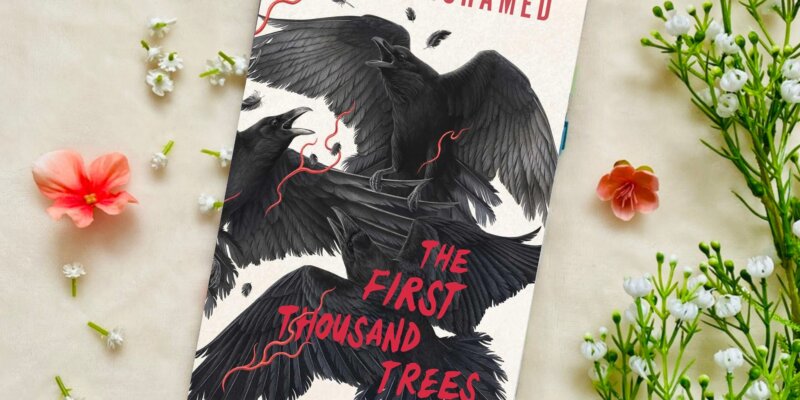
Thank you for joining us as we wrapped up this remarkable trilogy. Be sure to stop by tomorrow as we’ll be sharing our interview with Premee Mohamed to celebrate publication day for The First Thousand Trees!
Also check out The Moon of the Crusted Snow discussion here and The Moon of the Turning Leaves review here.

Be First to Comment